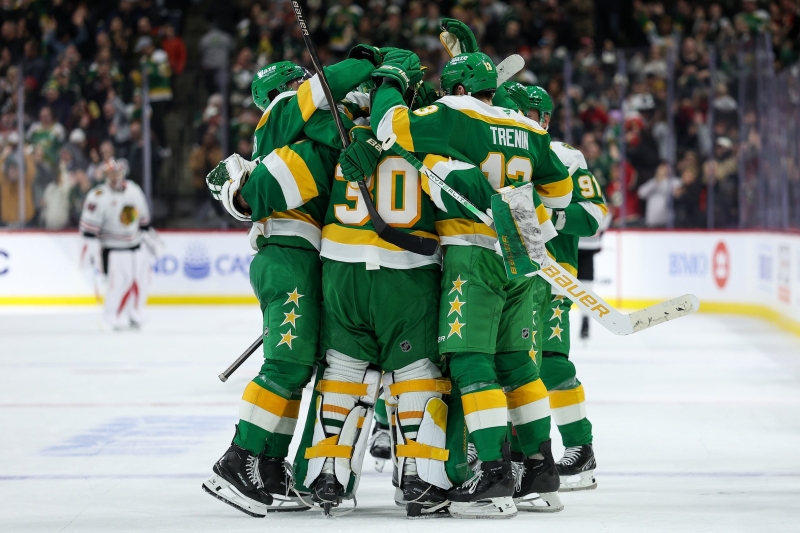
The Minnesota Wild have picked up points in five of their past six games, a reminder that patience with this group might be the smartest path forward. As tempting as it may be to shake up the roster, the way this team has handled adversity, leaned on its core, and integrated new pieces suggests that continuity could be its competitive edge in a league obsessed with change.
Minnesota’s comeback over Chicago was more than just two points in January; it encapsulated their identity. Down 3-0, they leaned on structure, special teams, and their leaders to claw back, kill penalties, and eventually win in a shootout behind Jesper Wallstedt’s perfect performance in the skills competition.
Goals from depth scorers like Yakov Trenin and captain Jared Spurgeon highlighted how this team doesn’t need everything to run through one line to flip a game.
The Chicago game wasn’t a one-off either. Minnesota has gone 4-1-1 in its last six, climbing to 29-14-10. They are second in the Central Division and on a pace that looks a lot more like a contender than a bubble team. They’re not benefitting from lucky bounces; they’re winning different kinds of games, from tight defensive battles to track meets that require offensive bursts and composure late.
For all the talk of what the Wild still need, they have established a foundation. Kirill Kaprizov, Joel Eriksson Ek, Matt Boldy, Brock Faber, and a veteran spine featuring Spurgeon, Jonas Brodin, Marcus Foligno, and Mats Zuccarello. Kaprizov continues to be the game-breaker, leading the team in goals and points and delivering in the biggest moments, like the shootout winner against Chicago.
Eriksson Ek remains the heartbeat down the middle, doing the thankless work between the dots, killing penalties, driving possession, and chipping in offense, as he did with a goal and an assist in that comeback.
Younger players like Faber and Danila Yurov are logging real minutes and learning what it means to win at this level without being asked to carry the whole load yet. That’s the benefit of continuity: prospects get to grow into defined roles alongside established leaders, rather than being thrown into chaos every season. Veterans know the system, the expectations, and each other’s tendencies, which lets them elevate the kids instead of just trying to survive.
The standings tell part of the story. The Wild are sitting near the top of the division with a positive goal differential and legitimate top-end talent. Blowing up a group like that usually sets a team back years, especially in a cap era where drafting and development are supposed to be your advantage. Good teams don’t hit the reset button after every rough month. Minnesota’s recent results show that, when healthy and connected, this roster has already figured out how to win the tight, playoff-style games they’ll need in April and May.
Continuity also matters in how a team actually plays. Systems become second nature when you’re not cycling half the room every summer. It helps players establish that half-second of instinct of knowing where Kaprizov wants the puck, where Spurgeon will close a gap, where Eriksson Ek is net-front, which often decides games. Keeping the group together sharpens that chemistry instead of sending everyone back to square one.
There’s also the salary-cap reality: Minnesota is not a big-market team that can paper over every mistake with a blockbuster signing. Their path has to be draft well, develop patiently, and keep the right players together long enough to build a true window instead of chasing quick fixes. With Kaprizov in his prime, Boldy maturing, and Eriksson Ek still in his late 20s, this current core’s timeline aligns with the next wave of talent like Wallstedt, Danila Yurov, and Charlie Stramel.
Keeping this roster largely intact doesn’t mean standing still. It means making smart, surgical moves around a core that has already proven it can contend in the Central. If the last stretch of games is any indication, the Wild may not need a dramatic overhaul to break through. Instead, they need more time together to push this familiar group from dangerous to downright terrifying when it matters most.