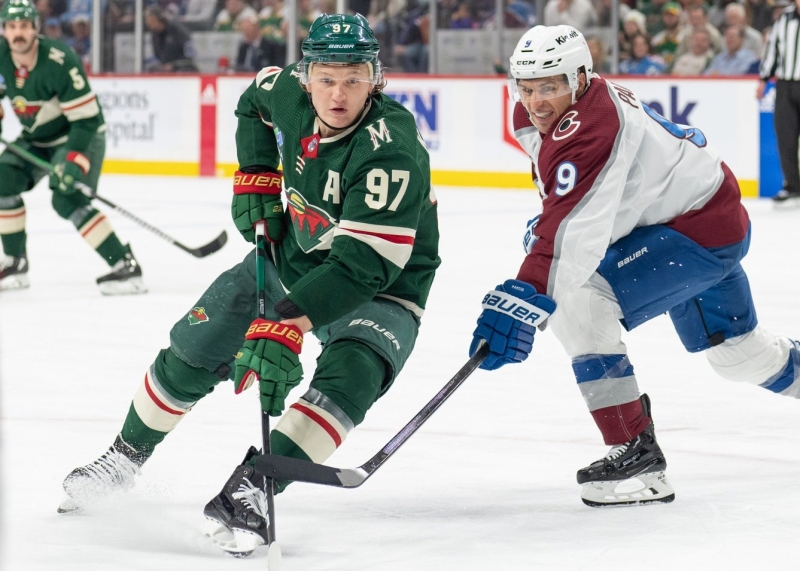
The Minnesota Wild’s plan is pretty clear by now. They’ve got Kirill Kaprizov and Quinn Hughes, two superstars at the peak of their powers. The Wild paid a steep price to keep Kaprizov around and will presumably try to retain Hughes by any means necessary. After that, they’ll have two highly-paid cornerstones to build around long-term.
What could go wr — Never mind, you already know.
This is, of course, the same basic recipe Chuck Fletcher concocted for the Wild in 2012. Craig Leipold opened up the wallet and dumped its contents at the feet of Zach Parise and Ryan Suter, spending $198 million in a single Independence Day.
It’s hard to say the two players weren’t worth the cost. Injuries eventually slowed Parise down, but he played over 550 games and scored 400 points during his time in Minnesota. Suter was a rock for the Wild defense for almost a decade, with 369 points of his own.
But the Parise/Suter Wild had a ceiling: The second round. If they were lucky. The return on investment for ownership paid off with exactly five home dates past the first round in those nine years, with four years of buyout-induced cap hell restricting them afterward.
That’s what can go wrong.
How hard is it to imagine things going wrong with a Kaprizov/Hughes core? Not particularly. We’ve already seen Kaprizov spend half a season sidelined with injury. Kaprizov is currently the league’s highest-paid forward, and Hughes may well become the highest-paid blueliner. Minnesota is likely to have $30 to 35 million tied up in two players in 2027-28, or about 26 to 31% of the cap. Parise and Suter, by contrast, took up around 25% of the salary cap in 2012-13.
The Parise/Suter Wild had difficulty building around Parise and Suter, even with a robust prospect pool. Meanwhile, the Kaprizov/Hughes Wild had to clear out a good chunk of the prospect pool to assemble themselves, and are looking to take another bite at the trade deadline.
The parallels seem frightening, except for one crucial fact: This time, the Wild are building around the right superstars.
That is to say, both players are superstars. That sounds like a slight to Parise and Suter. It isn’t. Parise and Suter have each had great careers; they’re both shoo-ins for the U.S. Hockey Hall of Fame. It’s hard to imagine either of them making the Hockey Hall of Fame, proper, in Toronto.
The two players hitting free agency at the same time in 2012 was a spectacle, and fueled the hype for each of them. But when you strip that away, the two players were more-or-less on the wrong end of the arbitrary line between “star” and “superstar.”
Parise came closest, scoring 45 goals and 94 points in a career year in 2008-09. Only Alexander Ovechkin and Jeff Carter scored more goals. He finished fifth in Hart Trophy voting, which is significant. It would be the only top-10 finish of his career, though.
In the five years leading up to Parise’s free agency, he ranked 14th among forwards with 26.1 Standings Points Above Replacement, per Evolving-Hockey. Granted, that’s more impressive than it first appears. Parise missed all but 13 games in the 2010-11 season, and would likely have been in the back half of the top-10 if he stayed healthy.
Parise was arguably on the threshold of superstardom. With Suter, it’s clear he was a bit further away. Remember, he wasn’t considered the best defenseman on his own Nashville Predators, with the numbers backing up Shea Weber as the better of their top defensemen. Suter found himself out of the top-15 in SPAR for defensemen in the five seasons before signing in Minnesota, tying with Paul Martin for 17th (17.8 SPAR).
Undoubtedly, the two moved the needle for the Wild. Just not enough.
It’s different when it comes to Kaprizov and Hughes. The Wild are simply operating from a higher baseline. Looking at SPAR from the 2021-22 season to today (the five seasons before his mega-deal kicks in), here’s how the top-10 forwards stack up:
- Connor McDavid, 43.9
- Nathan MacKinnon, 36.1
- Auston Matthews, 34.5
- David Pastrnak, 33.5
- Jason Robertson, 30.5
- Nikita Kucherov, 30.2
- Leon Draisaitl, 29.7
- Mitch Marner, 29.7
- Roope Hintz, 27.6
- KIRILL KAPRIZOV, 26.3
The numbers tell us he’s on Parise’s footing, and the eye test puts him easily on the “superstar” side of the line. His play has yet to get him a major award outside of his Calder Trophy, though it’s important to remember he was a Hart favorite before getting injured last season.
As for Hughes, he plays his position like Tina Turner: simply the best. Here are the top-10 defensemen in SPAR over that same time:
- QUINN HUGHES, 29.3
- Cale Makar, 25.7
- Adam Fox, 24.6
- Thomas Chabot, 22.0
- Roman Josi, 22.0
- Josh Morrissey, 21.4
- Evan Bouchard, 20.0
- Esa Lindell, 18.7
- Jaccob Slavin, 18.5
- Miro Heiskanen, 18.3
It’s the Hughes side of the equation that feels like the real game-changer when comparing to the Parise/Suter Era. Suter was a high-end defensive defenseman and minute-muncher, with merely fine offensive utility. Going back to the five years before signing with the Wild, Suter’s impact on the Predators’ 5-on-5 goal-scoring was -0.01 goals per hour, or virtually none. To name some forward equivalents, he affected the offense as much as Blake Comeau or Matt Cooke.
Meanwhile, Hughes is one of the very few defensemen who drives offense like an elite forward.
5-on-5 Goals For Per Hour*, Relative to Team, 2021-22 to 25-26:
- Matthew Tkachuk, 0.96
- Nikita Kucherov, 0.86
- Auston Matthews, 0.73
- Nathan MacKinnon, 0.72
- David Pastrnak, 0.70
- Johnny Gaudreau, 0.64
- Robert Thomas, 0.63
- Anthony Mantha, 0.60
- Brayden Point, 0.60
- Jared McCann, 0.60
- Connor McDavid, 0.59
- Jason Robertson, 0.59
- Filip Forsberg, 0.58
- Jack Eichel, 0.58
- QUINN HUGHES, 0.58
What Hughes can do from the blueline is a legitimate superpower. He pushes the pace at 5-on-5 even more than superstars like Draisaitl (0.55), Kaprizov (0.52), and Artemi Panarin (0.50). Suter’s defense was solid, but it was hardly the difference-maker Hughes is on the offensive side.
We saw the results fizzle out, but the logic for the Wild in 2012 was solid enough. Talent is important, so bringing in the two most talented players available to them was a smart move, at least for a team for whom tanking has always been out of the question. But Parise probably wasn’t a franchise player, and Suter definitely wasn’t, and the Wild didn’t have anyone else that could settle into that franchise role until the duo was well past their primes at 36.
That’s not the case now. Hughes is indisputably a franchise defenseman, and most would consider Kaprizov to be a franchise forward. The tentpoles are sturdy, and the supporting cast of Matt Boldy, Joel Eriksson Ek, Jonas Brodin, and more round out the team. Minnesota’s not a finished product, or a sure thing yet, but if they lock in that Hughes/Kaprizov core long-term, they’ll be building on a much sounder foundation than they were in 2012.
*Minimum 3000 minutes