I’m going to talk about Thanksgiving a little bit here, which is a very strange thing to write about in January. Not only is the holiday ten months away, but there’s very little to be thankful for at this time in Minnesota.
The weather sucks. It’s so cold that dogs go unwalked for days in a row. The outdoor rinks go unused some nights, as the windchill dips below zero and fingers freeze before skates can be tied.
There is no beautiful autumn scenery; instead, the blaze maples outside my house are gray, as is the sky. The Minnesota landscapes are nearly monochromatic if it weren’t for the evergreens — and even their green is muted.
Even worse, Joel Eriksson Ek, Matt Boldy, and Jonas Brodin are missing from our televisions.
January is often associated with the new year, but it’s a terrible time for new beginnings. The ancient pagan cultures typically began their calendars on the Spring Equinox, a much more sensible time to pick up a new hobby. The sun is out, everybody has more energy, and it’s time to plant some crops.
On the other hand, January was a time for sacrifice and reflection. Early Romans didn’t even give the months of January or February a name — they just sat as a 61-day gap in the calendar that they’d very much like to forget about: a scary time in which they appeased the terrible forces that brought disease, drought, and blight.
A friend of mine once told me he imagines himself as a scientist locked in an Antarctic outpost for the month of January. Nothing so strange has ever made so much sense to me.
What the hell does any of this have to do with the Minnesota Wild, or Thanksgiving, then?
Well, American Thanksgiving is often seen as the time when the NHL standings start to clarify which teams are playoff-bound and which are pretenders. Many useful statistics, such as goal differential or the fancy expected goals metrics, also stabilize at this time, which is about the 20-game mark for most teams.
So, what happened 20 games ago?
Quinn Hughes played his first game in Forest Green.
With a sample size large enough to evaluate whether a team is likely to make the playoffs, it seems reasonable that this sample would give us enough information to compare Minnesota’s pre-Hughes roster to the post-trade roster.
Before diving into the numbers, there are a few crucial caveats, mostly related to injury. Losing key lineup players will naturally affect team-level statistics. Here are the major absences:
- Mats Zuccarello played 15 of 32 games before Hughes’s arrival, and 17 of 20 with Hughes in the lineup
- Joel Eriksson Ek played all 32 games before Hughes, and 16 of 20 with Hughes
- Jonas Brodin played 30 of 32 before Hughes, and 12 of 20 with Hughes
- Matt Boldy played all 32 before Hughes, and 16 of 20 with Hughes
Hughes has a reputation as an offensive dynamo, but experts haven’t reached a consensus on his defensive game. While his possession metrics are stellar, his slight frame raises questions.
Minnesota’s two best defensive players (Eriksson Ek and Brodin) missed parts of Hughes’s tenure, and Mats Zuccarello played barely half of the games before the trade. That could amplify the perception of Hughes’s all-offense reputation.
Keep this in mind as you peruse the numbers below. Still, missing three games of Zuccarello, four games of Eriksson Ek, eight games of Brodin, and four games of Boldy will have a more powerful effect on a lineup than losing 17 games of Zuccarello at this stage of his career.
Now, the numbers. All data courtesy of MoneyPuck.com and HockeyReference.com.
Let’s start with five-on-five metrics, because they are the stickiest metrics going forward. Of all game states, teams play the vast majority of minutes at even strength, so it’s the largest sample. That also makes it the most powerful predictor for the future.
Minnesota’s five-on-five goal differential hasn’t changed much (plus-2 in 32 games before Hughes vs. plus-4 in 20 games with Hughes). However, their underlying numbers are meaningfully better. Minnesota’s share of shots on goal, shot attempts (Corsi), and expected goals (xG) have all improved from poor to average.
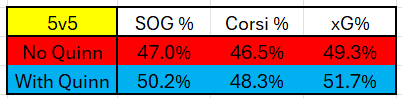
For reference, the pre-Hughes numbers would rank 29th in Corsi% (share of shot attempts) and 19th in xG%.
Breaking down the offensive and defensive metrics separately, the Hughes Effect is even stronger. Note that for defensive metrics, a negative percent change implies better defense.
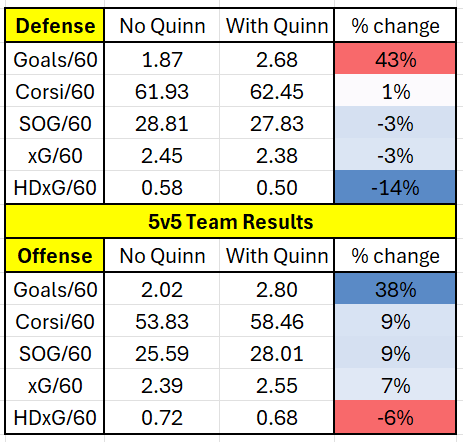
Minnesota’s even-strength goals per minute have exploded at both ends of the ice. However, the underlying metrics are encouraging. All numbers are per-minute to account for the uneven number of games played before and during Hughes’s stay in Minnesota.
On defense, Quinn Hughes’s Wild team has held steady or improved in shot attempts, scoring chance danger, shots on goal, and high-danger chances. These are the events that drive scoring, and the actions that Minnesota’s skaters can control.
Last year, the Winnipeg Jets had the best defense in the league, allowing 1.72 five-on-five goals against per game. Connor Hellebuyck won the Vezina Trophy. Only one other team, the Los Angeles Kings, was below 2 goals against per-game. The massive increase in defensive goals allowed is likely due to hot goaltending cooling off.
Offensively, it would be hard to ask for more. The underlying metrics indicate that Minnesota’s offense has likely improved, despite trading center Marco Rossi and offensive defenseman Zeev Buium to acquire Hughes.
While the 38% increase in goals-per-minute is partially a mirage, it’s also more likely to be a result of Hughes’s arrival than the 48% increase in GA/60. It’s hard to believe that Hughes’s play leads his goaltenders to have so much trouble saving pucks. Still, his exceptional passing could certainly influence a higher shooting percentage from his teammates.
Separating team performance into game states is typically more predictive than examining every minute of it. However, there are a few noteworthy figures that are not fully captured by separating five-on-five, penalty kill, and power-play minutes.
One example is goal differential. All-situations goal differential through 20 games is a powerful predictor of future performance. Before Hughes arrived, Minnesota was plus-6 through 32 games and plus-12 through 20 games. That’s a big difference, and it puts Hughes’s Wild team in rarefied air.
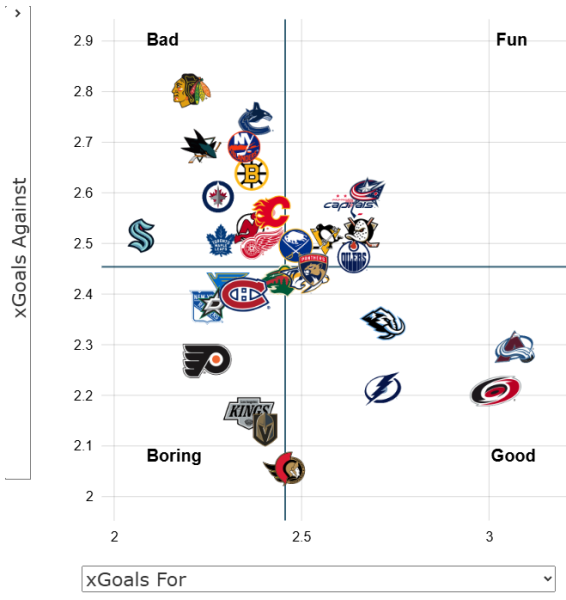
Through 20 games, the most similar teams are the Tampa Bay Lightning (+13), Washington Capitals (+14), Carolina Hurricanes (+11), Dallas Stars (+16), and Anaheim Ducks (+10).
Examining MoneyPuck.com’s 5v5 xG graphic from the time of this writing, it’s hard not to get excited about the quality of teams on that list.
Again, Minnesota’s underlying defensive metrics hold steady, and its offensive metrics blossom. Various measures of shot danger increased from 10% to 15%. That may sound small, but it’s a serious bump. Juicing the 2024-25 Wild’s 25th-ranked goals per-game by 12% would have improved them to 13th. That would have represented a .329 goals-per-game increase — another 27 goals per season.
Thinking of the Hughes trade as dropping a 27-goal scorer into the lineup for free, it sure sounds like exactly what Wild fans were hoping for before the trade.
The all-situations offense numbers are more pronounced than their five-on-five counterparts for an obvious reason — they include Hughes on the power play.
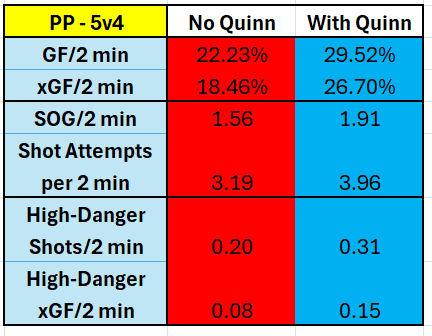
Before Hughes arrived, the Wild’s power play was only acceptable if you ignored the personnel. Despite rostering Kirill Kaprizov and Matt Boldy, it would have ranked 23rd in the league in goals per minute.
With Hughes, they rank 7th, just behind Tampa Bay and the Toronto Maple Leafs. By xG per minute, they would rank 9th. Despite Buium’s proficiency on the power play, adding Hughes took a bottom-ten power play and turned it into a top-ten unit.
Part of this improvement likely includes the return of Zuccarello, but it also includes four games without Boldy and Eriksson Ek. Boldy has been an exceptional one-timer threat, and Eriksson Ek is Minnesota’s best faceoff man and net-front scorer.
Altogether, the Zuccarello absence was probably more impactful. However, it doesn’t make it impossible to compare the two units on even footing, especially when the difference is this stark. Furthermore, it’s hard to watch Hughes run a power play, see the power play numbers skyrocket, and start looking for other reasons it’s more dangerous.
So, the Hughes trade is great. It’s improved the team’s offense without hemorrhaging defense, and the power play has hit a new level. This isn’t groundbreaking, but it’s comforting to know that it worked.
Taking things forward, though, the main benefit of Hughes is that he opens room to add at the trade deadline.
NHL teams are allowed to dress only 18 skaters for each game, and only five are on the ice for most of it. Hughes takes up only one of those spots. Improving the team and opening lineup spots undoubtedly makes the team thinner. Still, it’s easier to improve a thin team than a deep team.
To make serious improvements, deep teams have to find a way to acquire a superstar. On the other hand, a thin roster only needs to patch holes. For the Wild, those holes are on the second line and up the middle. Depth centers and second-liners are typical trade deadline fodder.
Soon, another season of sacrifice will be upon us — the March 6 trade deadline. Ironically, that’s near the spring equinox, when the ancient calendars turned over to the new year.
I don’t love that I’m leaving you with another reason to look forward to the end of this wintry hellscape. Life should be lived in the moment.
To that end, enjoy every game of Quinn Hughes on the Minnesota Wild. The trade is a success, and Hughes is brilliant.