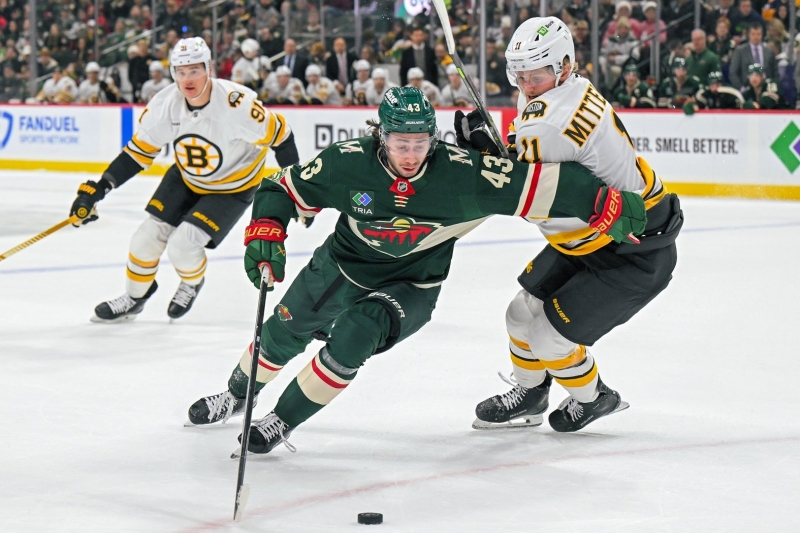
“I’m not gonna stop doing something because the end is bad. ‘Mitch, do you want an apple?’ ‘No, it will eventually be a core.'” — Mitch Hedberg
The Minnesota Wild traded for Quinn Hughes, a franchise defenseman, and while many are excited, some couldn’t see the apples Hughes would bring, but only the core. In fairness, we’re talking about a fanbase hard-wired to scan for doomsday scenarios, and there are indeed ones to hyperfixate on, if one so chooses.
As anyone will tell you, the Wild gave up a lot for Hughes. A top-six center in Marco Rossi, a blue-chip prospect in Zeev Buium, and Liam Öhgren were in the NHL this year, and are all under 25. That could’ve been a substantial part of the team’s core for the next half-decade. Heck, Buium has the talent and resume to be a franchise cornerstone.
All for Hughes, who is only under contract for the rest of this season and next? Whose agent said, “I wasn’t able to guarantee to any of the teams whether he would sign or not?” A player who has a landing spot so obvious that even his former President of Hockey Operations openly speculated about him playing with his brothers in New Jersey?
How is this going to work? If Hughes doesn’t extend with the Wild this summer, what do they do? Try riding it out and shooting their shot at a Cup? Try flipping him at the draft to recoup assets, as the Carolina Hurricanes did last year when they pulled off the shocking trade that acquired Mikko Rantanen? After the saga the team underwent to get Kirill Kaprizov to re-up in Minnesota, is the State of Hockey really going to go through that again?
Bill Guerin seemed unconcerned with all that at a Saturday press conference. “Can you give me one day?” the GM asked jokingly in response to being asked about extension talks in the summer.
It’s now been two days, so let’s fire up the speculation machine. We’re smack-dab in the honeymoon phase of this trade. The Wild rolled out the private jet and red carpet for Hughes. He scored his first goal in a dominating win in his debut, and he’s saying all the right things.
But even acknowledging that, yeah, of course the vibes are going to be good, it’s tough for me to get caught up in the What-Ifs surrounding Hughes’ contract. I suspect you need convincing, so here’s my thought process.
1. Hughes Has Already Chosen Minnesota Once
Hughes may not have had trade protections, but he was absolutely in control of his destination. Beyond Jim Rutherford giving him and agent Pat Brisson input — “[Rutherford] wanted me to go where he thought I’d be happy,” Hughes said — Hughes’s indication that he’d re-sign at certain destinations would likely have upped what teams were willing to pay. Hughes had the power to kill a deal that’d send him to Minnesota.
He didn’t. He chose the Wild, which puts them ahead of the game as compared to where they were with Kaprizov this summer. Kaprizov never truly chose the Wild until he put his name on that $136 million extension.
Sure, he arrived from Russia, and didn’t go back to the KHL, or force his way to another team. But Minnesota drafted Kaprizov, giving it ironclad control over his rights. When he extended after his rookie season, it was the Wild or CSKA Hockey. There wasn’t a time when Kaprizov had a list of potential suitors and gave Minnesota the Bachelor Rose.
Hughes did it once; who’s to say he can’t do it again?
2. He’s Taking Things Personally
A big reason Hughes chose Minnesota appears to be that Minnesota wanted him more. Teams were trying to bite on Hughes without giving up their best players or prospects. The Washington Capitals wouldn’t give up Ryan Leonard. The Philadelphia Flyers weren’t willing to surrender a top young NHLer like Matvei Michkov. Hughes’ hometown Detroit Red Wings nor the Devils would dig deep to land him.
Guerin was incredibly willing to go all-in, claiming that his offer — essentially, four first-rounders — was his first and only offer to Vancouver. It flies in the face of the generally accepted rules of negotiation. Still, Guerin was adamant during Sunday’s broadcast that he made his best offer first because “I wanted [Vancouver] to know we were serious.”
What seemed to really work was that it communicated to Hughes and Brisson that the Wild were serious about wanting him.
“I really appreciate him trading the assets that he did to get me,” Hughes said of Guerin after the game. “Some teams, they’re in until they hear what they have to trade to get me, but Billy, he was just full-in.”
Hughes would have sounded offended if he wasn’t so soft-spoken. Stars have egos, and being a former star, Guerin knew what buttons to push to flatter Hughes and make an impression. It certainly seems to matter to Hughes.
3. About $35 Million
Having Hughes in-house means Guerin can double down on him in a way other teams can’t. The CBA rules changes that take effect in September 2026 will prevent teams from extending players for 8 years. That means from July 1 to September 15, the Wild have a monopoly on an eight-year extension for Hughes. If the Wild don’t trade Hughes’ rights before he hits free agency, they’ll also be the only team that can offer him more than six years.
Sorry to the Wild fans who had a heart attack at Kaprizov’s $17 million AAV, but it’s hard to see a reason why Hughes should want less. And if the Wild are willing to “quote, unquote, sack up,” in Hughes’ words (which, for our purposes, case refers to a Scrooge McDuck-style sack of money), with a Kaprizov-style offer, they’ll be offering about $35 million more than anyone else can. Kaprizov couldn’t walk away from that kind of money. What makes you think Hughes would?
4. Team Chemistry Might Actually Really Matter To Hughes
We can tout that the Wild are contenders — and I think they are — but presumably, anywhere Hughes goes would probably win a lot of hockey games. The New Jersey Devils are a borderline contender with only two Hughes’. Detroit plus Hughes could well be a contender. So would many UFA destinations.
Where Minnesota has its edge is in the locker room. Guerin has been intentional about ensuring the vibes in St. Paul are always good. The players joke and wear goofy shirts to celebrate their teammates. Led by captain Jared Spurgeon, the Wild go out of their way to make sure everyone feels included, which is undoubtedly the reason why Hughes got the Wild’s Redwood Hat on Sunday, which is handed to one player after victories.
It’s easy to dismiss that dynamic, especially since it didn’t seem to give Minnesota a break when it came to re-signing Kaprizov. But Hughes might also be more prone than most players to value the locker room Guerin has built.
The Canucks won their division with Hughes only two seasons ago, but collapsed last year after a locker room feud between J.T. Miller and Elias Pettersson. As captain, Hughes had to navigate what happens when teammates hate each other so much that they needed to be organizationally separated, with Miller going to the New York Rangers.
He told Pierre LeBrun before this season, “I was proud of myself just because I tried to help out those guys, and also, there was a lot of nonsense on the side, but my game never dipped. I always felt like I was there for my team…. But, obviously, it was a distraction.”
Hughes is going from a team that’s dead-last in the league to one that is ready to go toe-to-toe with the Colorado Avalanche and Dallas Stars, and that’s a big shift. That difference in ability to win — and win now — is going to be a big factor in whether Hughes stays in St. Paul or not. But maybe we shouldn’t underestimate the shift in going from a tense workplace to a relaxed one.
However it goes down the road, Wild fans, don’t only see the core of the apple. You get to see Hughes every night, skating like few others can, pushing the pace, and generating offense. This is a team that has the most legitimate shot at the Cup in their 25-year history. They have two mega-stars in their prime in Hughes and Kaprizov, a rising star in Matt Boldy, good goaltending, and a strong supporting cast.
Minnesota is taking its shot. Obviously, extending Hughes means their window will stay open longer, but that uncertainty shouldn’t overshadow the fact that it’s open now. What happens later, happens. Every second spent sweating the future as a fan is one that could be spent reveling in watching a real, actual contending team.