Let’s establish right away: A problem on the fourth line in January is not a crippling weakness.
NHL teams don’t live and die by their fourth line. That’s very good for everybody, because nobody has a good fourth line. The fourth line’s primary goal is to take up the five or ten minutes of ice time so that the top-nine forwards can get sufficient rest.
On elite teams, the fourth line might contain a few specialists who boost the penalty kill or help in the faceoff dot. For the most part, though, the only good fourth line is a cheap fourth line.
Still, Minnesota’s fourth line must improve before the playoffs.
The issue isn’t a matter of chemistry, but depth. While the fourth line could be any combination of six or seven players on a given night, the “fourth line” refers to Tyler Pitlick, Ben Jones, and Vinnie Hinostroza for the purposes of this article.
These players’ on-ice results have been god-awful. Jones, Pitlick, and Hinostroza have allowed opponents to score 80%, 75%, and 59.6% of the goals during their ice time, respectively. However, analytical measures are probably fairer since they ignore goaltending.
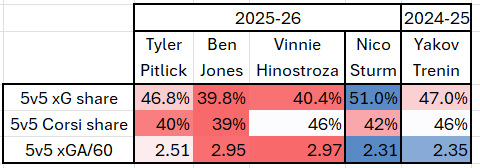
Using measures of expected goals (xG, a scoring chance danger metric based on shot location) and shot attempts (Corsi), they look much better. Still, they are well below 50% shares.
I know what the Fourth Line Defenders in this comment section will say: They do their job. They can get the puck over the red line, dump it in, and avoid getting scored on.
That’s simply not the case. Compared to Nico Sturm, the ideal fourth-liner, it’s obvious that Pitlick, Jones, and Hinostroza don’t defend well in comparison.
But Sturm is perhaps an unfair benchmark. He’s one of the league’s best fourth-liners. Let’s take it a step further and compare these three villains to a true Boogeyman of bad play: last year’s version of Yakov Trenin.
In case you’ve forgotten how Trenin’s 2024-25 season went, these are real tweets from Mike Russo, the standard of objectivity when it comes to reporting on the Minnesota Wild.
Yakov Trenin, the guy whom the Wild brought in not for his five-on-five play, but as a penalty kill specialist. Yakov Trenin, the guy who was somehow an albatross contract on a $3.5 million cap hit. Yakov Trenin, the guy catching strays for never shooting the puck, in November. November!
Even compared to that version of Trenin, these players give up far more scoring chances-per-minute and they don’t even come close to making up for it with their offensive play.
This trio must not see playoff ice time. At least, not as plan A.
In fairness to Wild management, the healthy Wild forward group would only include two of Pitlick, Jones, and Hinostroza. Their contracts carry small salary-cap hits, which make room for better players above them in the lineup. It also helps the team accrue cap space for the trade deadline.
If the fourth line can play games to a stalemate, the rest of the team can win during their minutes (or at least get to overtime, securing one point in the standings). Their role is to fill minutes as cheaply as possible, without ceding too many goals to the opponent.
However, that role will disappear after the trade deadline. Minnesota can’t loser-point their way to playoff victories.
That bears out when examining some of the 2024-25 contenders and the rosters with which they finished the year.
As a thought experiment, let’s compare Minnesota’s 2025-26 roster to last year’s Dallas Stars, Colorado Avalanche, Florida Panthers, and Vegas Golden Knights teams to find a comparable roster build. Using The Athletic’s analytical model and filtering only to players with a minus-three game score (about three goals of on-ice value below average, about the value of a third-line forward or third-pair defenseman), we can compare the major pieces of all five rosters.
The missing pieces create a trade deadline shopping list. Do the Wild need more top-end talent? More depth? Both?
There are a few conditions to keep in mind during this exercise:
- Minnesota’s numbers are from last year’s performance, as The Athletic has not yet released its 2025-26 player cards. For aging players, some regression should be expected.
- Players who did not meet The Athletic’s cutoff for playing time, such as Danila Yurov and Daemon Hunt, aren’t included.
- Because I suspect that Hunt, Yurov, and Sturm are playing at or above a third-line or third-pair level this year, I’ve included them for Minnesota; however, they may not actually meet the criteria above.
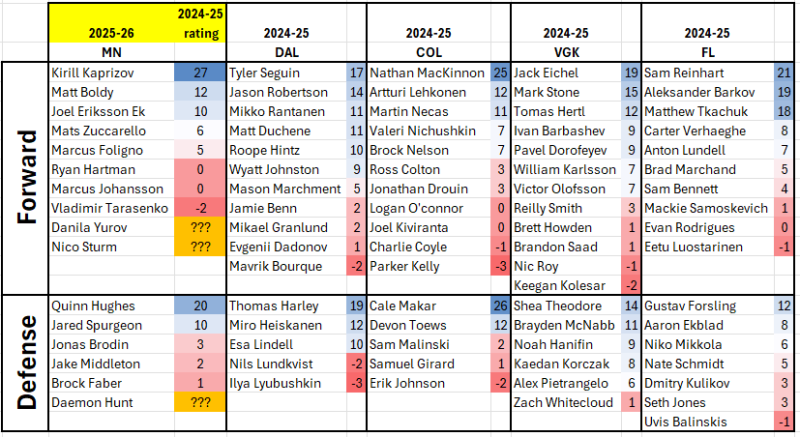
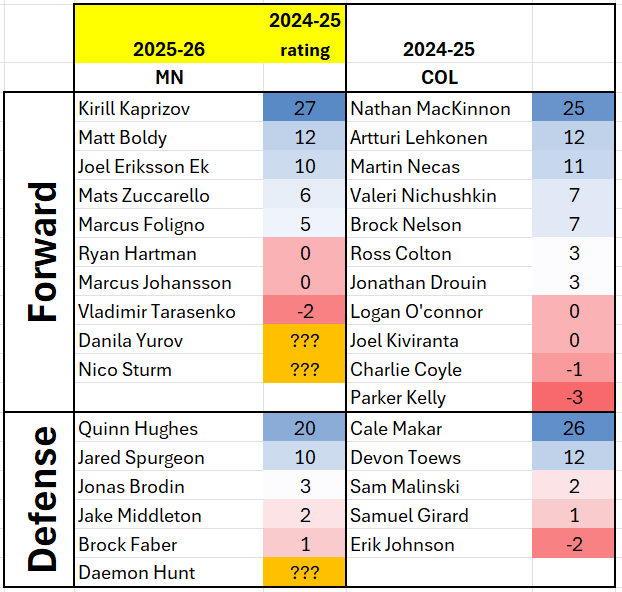
Minnesota’s roster compares favorably to the Avalanche more than any other. They both have an elite forward (MacKinnon and Kaprizov), an elite defenseman (Makar and Hughes), and a stable of top-six forwards to support those superstars. Both teams’ five best skaters can get on the ice together at once.
The obvious shortcoming of Minnesota’s roster compared to last year’s Colorado team is forward depth. That’s a product of Marco Rossi’s inclusion in the Quinn Hughes trade. However, it’s easy to see how Yurov and some trade deadline help bridge that gap.
Returning Minnesota’s fourth line, though, let’s compare the trio of Pitlick, Jones, and Hinostroza to Colorado’s postseason fourth line.
Colorado had 11 forwards who played all 7 of their playoff games. Gabriel Landeskog missed two games, so I’ll only examine the three forwards besides him who had the fewest five-on-five minutes: Jack Drury, Charlie Coyle, and Joel Kiviranta.
Their ‘24-25 five-on-five regular season analytics are shown below. Colorado’s group is significantly better than Minnesota’s.
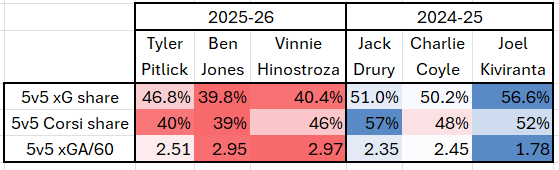
Here’s the thing: Pitlick, Jones, and Hinostroza are so close to being an NHL roster player that it doesn’t really matter if they’re holding back the roster. Minnesota’s roster should have no trouble reaching the playoffs. It would take an insane run of injuries to knock them out of the playoffs. If that happens, they’ll likely be too banged-up to win in the playoffs anyway. In other words, there’s no point planning for that eventuality.
Since the Wild can make the postseason with this roster, there’s no pressure to make changes immediately.
But remember that this trio is on the roster not for their April contributions, but for their contributions to the salary cap. Playoff opponents will identify Minnesota’s fourth line as a weakness if even one of Pitlick, Jones, or Hinostroza fills a spot on a fully healthy lineup card. On the road, opposing coaches will be able to target that weakness.
Bill Guerin’s first priority at the trade deadline should be adding depth to the forward corps. Adding two middle-six quality forwards would effectively address that weakness.