
Picture this:
You’re on your couch, favorite cold-weather snacks and beverages before you. Your favorite hockey team, the Minnesota Wild, is on television. The other team has committed some injustice punishable by two minutes in the box.
Huzzah! Time for an Xcel Energy Power Play!
But what’s this? They’ve lost the faceoff, and the other team dumps the puck. No matter. Surely regrouping and re-entering the offensive zone won’t be a challenge. Least of all with a five-on-four man advantage.
Plus, that new kid, Zeev Buium, can really skate the puck. Kirill Kaprizov drops the puck back at center ice, and with a head of steam, here comes…Jared Spurgeon? Brock Faber?
Frantically, you search the other forest green sweaters for No. 8, Our Savior. Alas, it’s nowhere to be found. 90 seconds of valuable top-unit power-play minutes seep away. Soon enough, the power play ends. The opponent’s infraction goes unpunished.
You’ve lost your appetite for those snacks and beverages. In its place, an appetite for John Hynes’s still-beating heart burns in the pit of your stomach.
If you think Zeev Buium is the best option to lead Minnesota’s power play, the data backs you up. When he’s on the ice, the Wild’s power play is at its most efficient in high-danger shots, shot attempts, and expected goals (xG). Those numbers are all on a per-minute basis, courtesy of MoneyPuck.com.
That’s not just because he gets to play on the top unit more frequently than other defensemen, either. If we filter Minnesota’s defensemen to power play minutes when Kirill Kaprizov is on the ice (a reasonable proxy for PP1 minutes), Buium still leads the team by a significant margin in all the most important numbers, according to NaturalStatTrick.com.

This impact also passes the eye test. As talented as Faber and Spurgeon are, neither of them matches Buium’s ability to carry the puck into the zone, work the blue line, and find his teammates in high-danger shooting lanes.
That’s why it’s supremely frustrating to see Buium’s share of ice time with the top power play unit diminished by minutes for Spurgeon and Faber. Again, using five-on-four time with Kaprizov as a proxy for PP1 minutes, Buium has played only 59% of the time.
Part of the reason for that is that Minnesota’s top two right-handed defensemen are capable power play quarterbacks. Over the past two seasons, their man-advantage impacts from The Athletic’s analytical model have been good-to-great. In 2023-24, Spurgeon and Faber ranked in the 99th percentile of defensemen by power play impact.
Part of that spectacular rating is that teammate and opponent impacts weren’t measured in the model for that season. In other words, playing often with Kirill Kaprizov (sometimes against opponents’ second- or third-best penalty kill units, given the 90-second shifts often given to Hynes’s top unit) heavily skews those 2023-24 power play impacts.
However, the numbers from the same model for the 2024-25 season do account for opponent and teammate impacts. Spurgeon’s results drop off dramatically to the 22nd percentile, but Faber still comes in at the 65th percentile. He’s not lighting the world on fire, but he’s certainly capable.
That partially explains why Faber and Spurgeon have been on the ice for 41% of the Wild’s top power play minutes. Combine Faber’s abilities with the fact that Buium is a rookie, and it’s not easy for the Wild to explain to Faber and Spurgeon why they would be reducing their power play minutes this season.
Even still, Buium’s effect on the Wild power play is noticeable beyond the numbers. It just feels more dangerous when he’s on the ice. He draws opponents into his gravitational pull and uses his unique skating and stickhandling to pass into dangerous areas. Why not use him all the time?
Simply put, Hynes has never stuck with one power play quarterback in either of his two previous seasons in Minnesota. Looking back at defensemen’s share of PP1 minutes in ‘23-24 and ‘24-25, Faber was typically the go-to guy. Even still, Faber only drew about 55% of available minutes with the top power play unit.
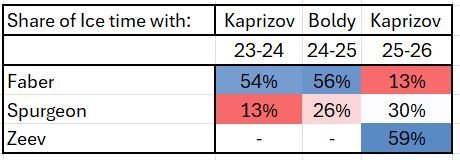
Note that for ‘24-25, minutes with Matt Boldy were used instead of Kaprizov, since Kaprizov missed half the season with injury.
With this context, it seems that the hair-pulling over Buium’s time on the top power play is overblown.
It seems this has less to do with Hynes demoting Buium and more to do with Hynes’s overall power-play philosophy. He relentlessly tinkers with the power-play quarterback.
Most likely, there is a good reason for that tinkering. If the point man is right-handed, he has access to different plays than a left-handed player. Faber and Spurgeon are more defensively responsible — especially Spurgeon, who has a better xG% in his five-on-four minutes.
That means that, after accounting for chances given up the other way, Spurgeon is more efficient on the power play. Hynes might prefer Surgeon against teams that deploy a more aggressive penalty kill system or whose penalty kill employs skilled scorers.
On top of that (and much to the chagrin of Wild fans who just want to see them let the kid loose!), top-unit power-play minutes are a powerful motivator. It’s easy to lose sight of the human aspect, but Buium is a 20-year-old rookie. Teaching him to be a professional athlete is part of his development.
That doesn’t mean that Hynes is right for reigning in Buium’s PP1 minutes, but it offers an explanation as to why it might be necessary, or even optimal.
So, try not to have a heart attack when Spurgeon or Faber is first over the boards next time Logan Stanley gets up to whatever evil action takes hold of his black heart. Buium is the team’s best power play quarterback, and the team seems to know that.